“No poet, no artist of any art, has his complete meaning alone.”
— T. S. Eliot
“No poet, no artist of any art, has his complete meaning alone.”
— T. S. Eliot
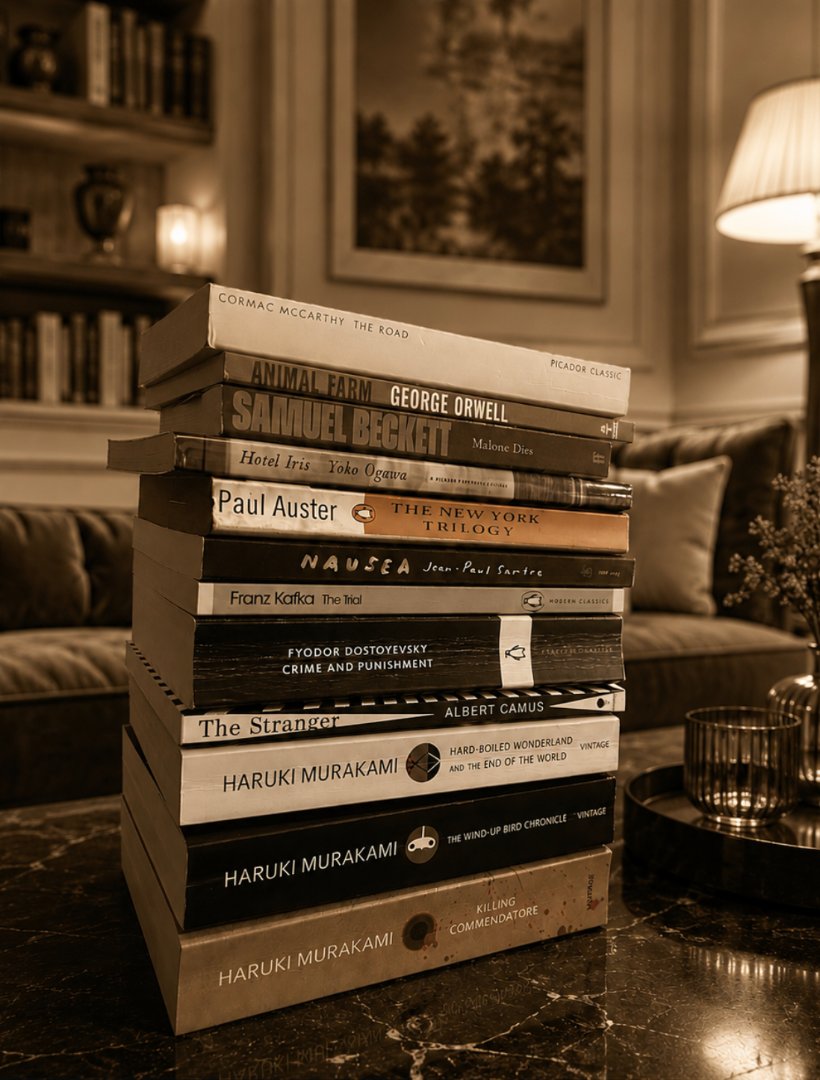
The novels below know my fingerprints by heart. I’ve turned their pages slowly, and more than once, not for the story but to catch the moment a sentence does something I didn’t know a sentence could do.
The Wind-Up Bird Chronicle
The protagonist barely acts. He stays at home, eats spaghetti, listens to music, answers the phone, and yet the book never slackens, because Murakami lets the world arrive at his door instead of sending the hero out after it. The momentum is all intrusion, not agency. The prose stays plain, almost flat, and that flatness is exactly what makes the strange parts credible: when the sentences refuse to act surprised, neither do we.
The Stranger
Meursault reports his own life without emotion, and Camus never fills in for him. The prose stays flat and exact. Short declaratives, events set down without comment, a narrator who registers the heat and the light instead of his grief. The same blankness covers his motive: he kills a man, offers no reason worth the name, and refuses to assemble a why. Camus withholds both the feeling and the reason, and the reader, unable to bear the gap, leans in and supplies them.
The Road
The dialogue is stripped to almost nothing. No quotation marks, few tags, often a single bare word. The father and the son say okay to each other over and over, and it is never the same okay twice: one is reassurance, one is surrender, one is a held breath, and you always know which without being told. McCarthy proves how much a plain word can carry when everything else has been taken away. The meaning was never in the word but in the silence and the situation around it.
The Trial
Kafka drains the impossible of shock. A man is arrested one morning and never told why. The events are narrated exactly the way ordinary ones would be, never doubted, never explained. Everyone around him treats this as normal; only the accused, and the reader, sense that something is wrong. And the charge never comes: Kafka withholds the crime for the whole novel, so the guilt has nothing to attach to, and the calm of the telling is what makes it unbearable.
Beneath much of what I write runs Carl Jung: the slow labor of becoming whole, the shadow we refuse to know, the masks we polish until we mistake them for faces. His work matters to me because it doesn’t ask us to defeat darkness, but to meet it without being ruled by it. Other voices I keep returning to, off the page and outside fiction: Nietzsche, Schopenhauer, Cioran, Peter Wessel Zapffe, Viktor Frankl, and Alan Watts.
The Newsletter
I'll email you almost never. When I do, it's a story.